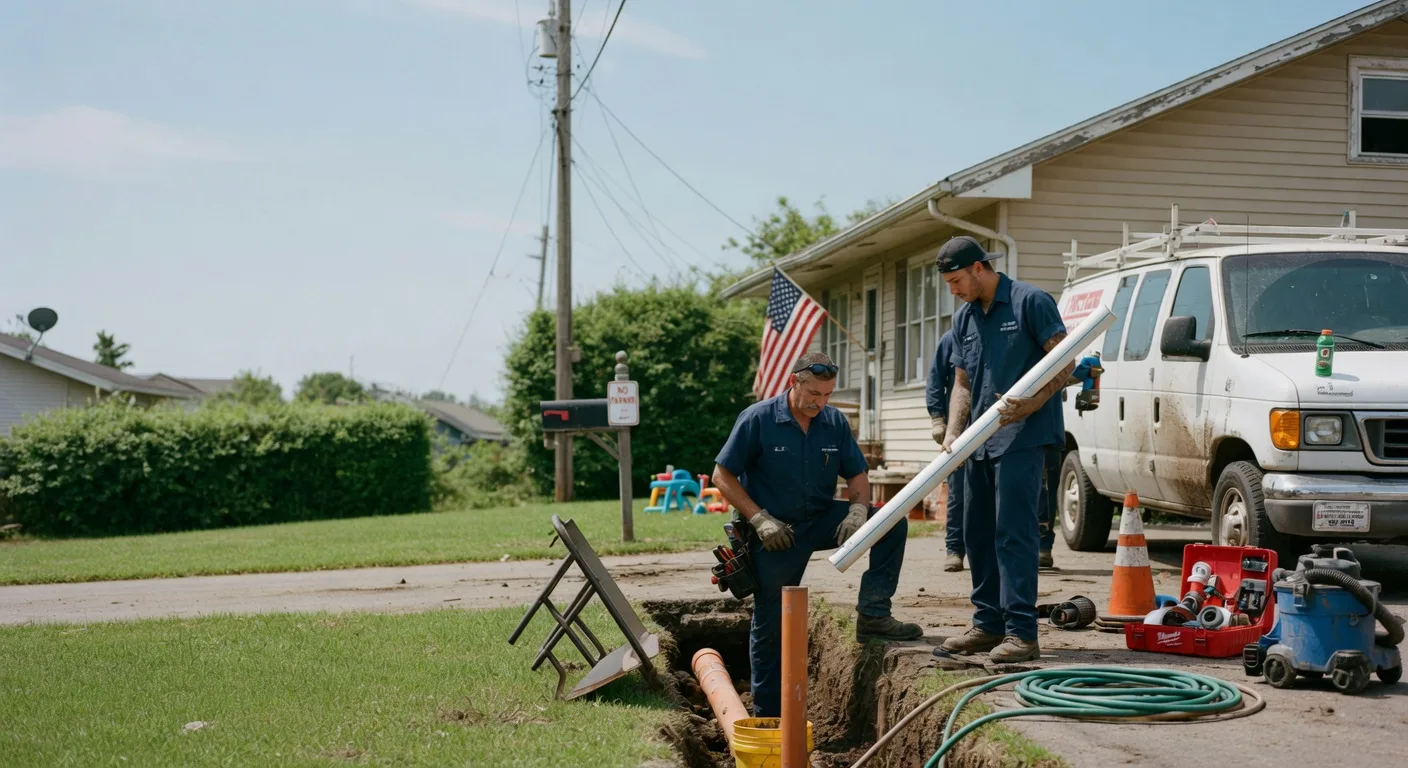
The street sewer backed up into my house. What is a backwater valve?
Sewage came up through the basement floor drain, or a low toilet or tub gurgled and overflowed, during a storm or a heavy-use evening.
The usual cause is the municipal main in the street filling past capacity, called surcharging. With nowhere to go, the flow pushes back up the lateral and out of the lowest opening in the house.
A backwater valve, also called a check valve, is a fitting on the lateral or building drain with a flap that lets waste leave and shuts when flow reverses. It sits on the line ahead of the branches serving the lowest fixtures.
Fitting one is not a quick swap. It usually means opening the floor or digging to reach the pipe. What it involves depends on access, the depth of the line, the valve and materials, how much has to be opened up and restored, and whether a permit or code sign-off is required. Rules vary by area.
A valve does not fix roots at a clay joint or a bellied line holding water. It only stops reverse flow. A private line problem needs a camera inspection first, then a cable machine or hydro jetting depending on what the camera shows.
Street or private? Ask three things. Are the neighbors affected? Did it coincide with heavy rain? Is only the lowest opening backing up while upper fixtures drain normally? Yes to those points to the street main. Only your house, in dry weather, points to your own lateral.
Safe homeowner check: look at the neighbors and the forecast. Stop running water now: no flushing, washer or dishwasher. Keep people and pets out of contaminated water, and call.
Expert Plumbers Co is a referral service. We connect you with an independent local plumber in Mapleton, OR. Call (380) 262-9173.
After the cleanup, ask how the valve will be kept working. The flap and its hinge can be stopped by lint, grease and grit, and then it no longer seats fully. Most valves have an access cover so the flap can be looked at and cleaned, and that should be done on a routine, not only after a storm. Learn where the cover is and keep boxes and floor coverings off it.
One point catches people out. With the valve closed during a storm, your own household water has nowhere to go either. Showers, sinks and the washer will fill the line behind the flap, so keep water use low until the street main drops.
After any backup, the floor drain and the area around it need to be cleaned and disinfected. Porous materials that soaked up sewage, such as carpet pad and cardboard, usually have to be removed rather than dried.
What should I tell the plumber on the phone so the right equipment turns up?
Describe what the water is doing and how often it has happened. Those two details decide which tool is needed.
When you call Expert Plumbers Co, a referral service, we ask the same questions. The answers shape the referral to an independent local plumber.
One fixture or every drain? One slow sink is a branch line, and a cable machine often handles it. Every drain backing up points to the main line or a blocked vent stack, which is a bigger job.
Is water rising, or just slow? Rising water means the line is nearly shut. Say so first.
Does anything gurgle when another fixture runs? Gurgling suggests a blocked vent stack or a partial blockage in the main line.
How long has it been happening, and has it been cleared before? A repeat blockage points to a fixed fault, such as root intrusion at a clay joint or a bellied line holding water. Another cable run only buys time. That is a camera inspection case.
Is there a cleanout, and roughly where? Access changes how the equipment gets in.
What is the pipe made of, and how old is the house? In older housing stock, clay and cast iron are common. Clay joints let roots in. Cast iron can scale up inside.
Septic tank or city sewer? A septic system changes where the problem can sit and which tool is safe to use.
Basement or slab? A basement often gives a lower access point. A slab can mean opening the floor or working from outside.
What the work involves depends on access, the pipe materials, how much has to be opened up and any permit or code requirement. Call (380) 262-9173 and we will refer you to an independent local plumber in Mapleton, OR.
Have a few practical things ready before the plumber arrives. Clear a path to the cleanout, the basement or the crawlspace, and move stored items out of the way. Know where the main water shutoff is and be ready to show it.
If you can, take a short phone video of the symptom, such as water rising in a tub when the washer drains. Intermittent problems often vanish by the time anyone arrives, and a video shows what the water was doing.
Mention anything poured down the drain recently, including chemical cleaners. Those affect which tools can be used safely, and the plumber needs to know before reaching into the line.
Say if pets or small children are in the home, and keep your phone nearby, because the plumber may call to confirm the address and access details. Answers ready on the first call shorten the visit and help the right equipment arrive the first time.
Can I watch the camera footage from my sewer line, and what should I ask the plumber to show me?
Yes, you can ask, and a plumber who does this work properly will usually be glad to show you. The picture is the clearest evidence there is of what is happening inside a pipe you cannot see.
Most inspection cameras feed a small monitor at the cleanout or a tablet held by the plumber. Ask to watch it live. Ask to see the footage again afterward, and whether it was recorded. A recording matters if you later need a second opinion, a repair quote from another plumber, or a record for a home sale.
Here is what to ask to see.
The start of the run. A clean, round pipe wall tells you the line was open and what material it is, such as clay, cast iron or plastic.
Any joint that looks offset, cracked or separated. Ask the plumber to pause on it.
Root growth. Fine roots look like hair or threads at a joint. Heavy roots fill the pipe like rope.
Standing water. A section that holds water is a bellied line, a low spot where debris collects. Ask how long the section is.
Scale or heavy buildup, especially in cast iron, where the wall looks rough and lumpy.
The end of the run. Where did the camera stop, and why? A collapse, a hard blockage, or a break all look different.
Then ask how far from the cleanout each problem sits. Many cameras carry a footage counter or a locator that finds the spot from above. That distance is what tells you how much digging a repair might involve.
A few cautions are worth knowing. The image can look worse on a small screen than it is, and a single hairline crack is not the same as a collapse. A plumber should be able to say which it is and what it means for the next step. If the camera could not pass a blockage, ask what is beyond it, because the camera has only seen part of the line.
What camera work adds to a visit depends on access and how long the run is, and it often heads off a repair based on a guess.
If you need a drain cleared in Mapleton, OR, Expert Plumbers Co can connect you with an independent local plumber at (380) 262-9173.
The furnace or air conditioner drains into my basement floor drain and now it overflows. Is that a drain cleaning job?
"The furnace drains into my basement floor drain and now it overflows." That is a common one, and it is a drain problem with two parts. The overflow can come from either end: the small condensate line, or the floor drain it empties into.
Condensate lines clog with algae and sludge. Once it blocks, water backs up at the unit or spills from the line onto the floor. Many systems also have a trap on that line, and the trap is the first place sludge collects.
The floor drain itself can be the problem. If it is slow or backs up when you run the washer or a tub upstairs, the cause is in the house drain: grease build-up, a bellied line holding water, or root intrusion at a clay joint further out.
One slow floor drain, with the rest of the house draining fine, usually means a local blockage in that branch. Every drain in the house backing up, or the lowest drain gurgling and rising while others run, points to the main line or a failed sewer lateral.
Safe homeowner check: Look at the pipe from the unit. Is water standing in the pan or trap? Pour a bucket of water into the floor drain and watch how fast it goes. Do not pour bleach or drain chemicals into the condensate line without knowing the unit's instructions.
Stop running water and call now if the floor drain is bringing up sewage or a sewer smell, other drains in the house are slow or gurgling, water is spreading toward electrical equipment or the furnace, or the overflow comes back soon after you clear it.
A cable machine is often enough for a plain clog in the floor drain branch. A condensate line is a different job: it needs flushing or clearing at the line and trap, and may need a cleanout fitting added. If the floor drain keeps backing up, a camera inspection shows whether the main line has roots or a belly. Hydro jetting is used when grease or scale coats the pipe wall.
Expert Plumbers Co is a referral service. We connect you with an independent local plumber in Mapleton, OR. Call (380) 262-9173.
Ask the plumber to check both the condensate line and the floor drain, and to explain which one failed. Ask whether the condensate should drain somewhere else, since rules vary by area on where it may discharge. Cost depends on access, the parts needed, how much has to be opened up or removed, and any permit or code requirement.
Water shows up around the base of the toilet after flushing. Is that the drain or the seal?
"There is water around the base of my toilet after I flush." Water at the floor can come from three places, and only one of them is the drain.
The most common cause is a failed seal. A toilet sits on a wax ring or a rubber seal that joins it to the flange, the fitting on the floor drain. If the ring is crushed or the toilet rocks, water escapes at the base during the flush. A loose bolt, a cracked flange or a flange set too low can do the same.
A drain problem is the other case. If the toilet is partly blocked, the flush water slows and rises, and it can push out at a weak seal. Grease build-up, a bellied line holding water, or root intrusion at a clay joint can all do this.
Here is the test. If only this toilet leaks and every other drain runs clean, think seal or flange. If the bowl drains slowly, gurgles, or the tub and floor drain are also slow, think drain. If every drain in the house is backing up, the main line or sewer lateral is involved.
Safe homeowner check: Flush and watch where the first drop appears. Press the toilet by hand to see if it rocks. Check the supply line and shutoff valve for drips. Look at the bowl: does it drain quickly or slowly? Do not over-tighten the closet bolts, because porcelain cracks.
Stop running water and call now if the water on the floor smells of sewage, the toilet will not drain or the bowl rises, other fixtures are backing up, or water is coming through a ceiling below.
A cable machine is enough for a toilet blocked by a clog close to the bowl. A seal or flange job is a reset, not a drain job: the toilet is lifted and a new ring and fittings go in. If the drain keeps slowing, a camera inspection can show roots or a belly, and hydro jetting is used for grease or scale coating the pipe wall.
Expert Plumbers Co is a referral service. We connect you with an independent local plumber in Mapleton, OR. Call (380) 262-9173.
Ask the plumber to say whether the problem was the seal, the flange or the drain, and what they checked. Ask if the subfloor is wet or soft, since that can widen the work. Cost depends on access, the parts or materials needed, how much has to be opened up or removed, and any permit or code requirement.